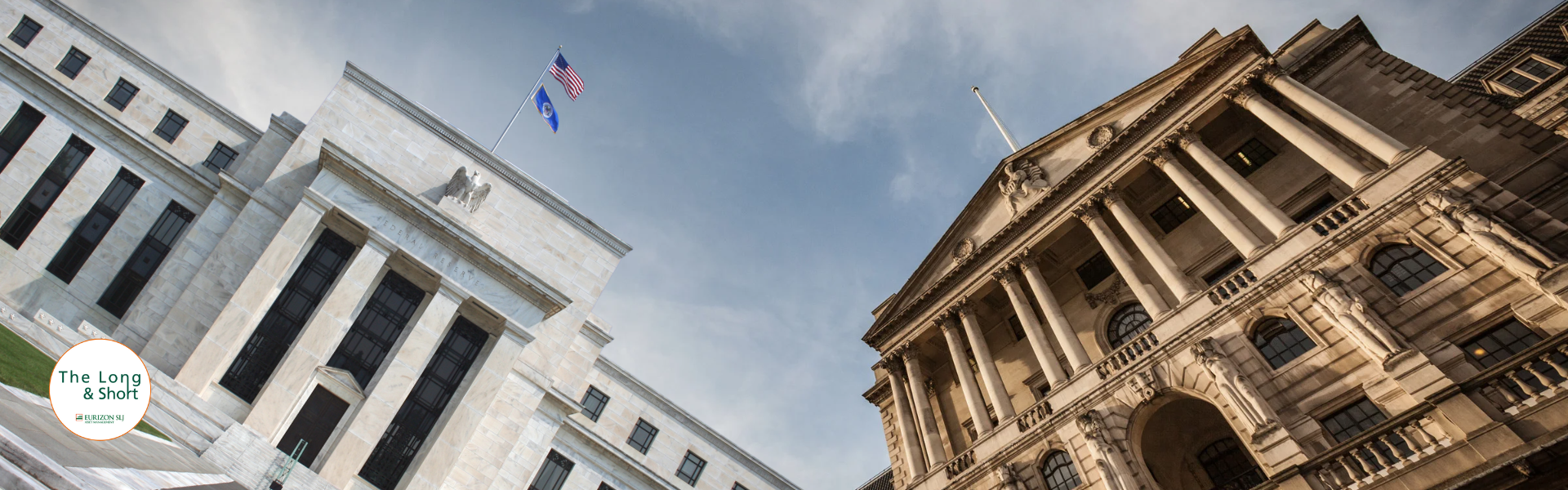
“Some might say that we should never ponder…“
Oasis, Some Might Say
Last week, we recapped some of the important developments or events through the summer period. In particular, the much-anticipated Jackson Hole event where, relative to expectations going into the meeting, we felt the market extrapolated a mild hawkish bias against our reading of the situation - expectations that ranged from discussions around a formally higher equilibrium level of rates, or r*, a raising of the inflation target, and even an explicit narrative around the need for higher rates due to a re-accelerating economy. These expectations were all disappointed. Instead, we saw The Chair of the Fed reference a backdrop of more balanced growth and inflation risks, against an already restrictive policy setting.
We highlighted that we would be sympathetic to the thesis that the Fed narrative is intentionally biased towards the hawkish side at the current juncture as a function of preventing market expectations easing policy pricing too quickly further out the curve - potentially encouraging a more resilient demand that adds to the persistence of inflation - as the Fed’s Chair alludes. However, outside of the communication preferences of the Fed, we remain of the view that the underlying momentum of domestic demand is significantly weaker than the current data currently implies. Whether this is a function of the lags of the huge pandemic fiscal stimulus (on households and local government), the rising consumer debt, diminishing (or diminished) excess pandemic savings and the end of the student loan repayment hiatus, or the distortion of current government programmes such as CHIPS, IRA and the Infrastructure bill - that have (among other things) positively distorted inward investment - remains unclear.
The other key market focus that we highlighted from recent weeks was the growth backdrop more explicitly, notably, the very weak German PMI data for July - but PMI data globally gave a much more modest indication of current global growth momentum. By extension, and in keeping with our Dollar Smile framework, we have seen some USD strength on the basis of US exceptionalism by default, that US growth has remained resilient relative to some more fragile signs from the global economy - fuelled by what is an extraordinary amount of procyclical fiscal stimulus in the US. A factor that is clearly exacerbated if not driven by China's demand weakness.
This week, however, we take a closer look at the UK. This week, I listened to the vice Chancellor of the University of Oxford excitedly commenting on the renewal of the UK’s membership of the Horizon research programme, and the implications of this, not just from the standpoint of scientific collaboration, but also from research grants and corporate investment as a result. Wonderful news, but not everything in the garden of England is so rosy.
Indeed, while it has been clear that the UK has suffered from a more acutely tight labour market / skills shortage than some other countries, and that the supply of services has also suffered shocks alongside the more obvious energy and goods supply shocks, demand has been increasingly weakening for a significant period of time, in our view. Regular readers will know that we have been firmly in the Tenreyro/Dhingra camp on monetary policy for many months now - concerned that the underlying domestic demand momentum is likely much weaker than some of the aggregate data (certainly price data) suggest.
This week, we have had commentary from a number of Bank of England Committee members that appear to suggest a much more even distribution of the balance of risks to growth and inflation. So much so that even with 43bps priced by the market now (a peak of 5.62%, down from its highest level above 6.50% - albeit temporarily) appears rich. We are increasingly of the view that the BoE may already be done.
At the end of last week, Bank of England Chief Economist Huw Pill gave a speech that highlighted a more balanced view of the growth inflation trajectory in which, while he stressed that core inflation and wages remain too high, that a lot of rate hikes are yet to impact the economy, and that there is the possibility of doing too much on rates in the UK. However, the phrase that caught our attention was the echoing of the Broadbent commentary at the last MPR press conference, where he stated that there are multiple paths for the BoE to reach its CPI goal. Essentially, inferring that instead of raising rates and then lowering them as the tighter financial conditions weigh further on growth in the future, that the Bank could achieve the same outcome through a credible commitment to keeping rates unchanged for an extended period. We believe this strategy is increasingly likely.
This week, Governor of the Bank of England stressed the future impact of rate rises still to come, and for the first time explicitly stated that we are near the top of the cycle on interest rates and that MPC members don’t know how they will vote in September (21st). On inflation, he stated that the fall will continue, and that despite the potential for a technical tick-up in the August data, that the subsequent fall will likely be “quite marked”. Testimony from Dhingra that “further tightening poses serious risks to growth” and Cunliffe that we are “starting to see mixed signals on the economy… [which] may indicate a turning point” added to the now significantly less hawkish tone at the Bank. Lower-than-expected inflation expectations data from the BoE this week also added to the dovish momentum in the rates space.
Next week, we get employment and GDP data from the UK and the CPI print for August is released the day before the rate decision. We believe that this is now likely to be a very close call. It is all about the Governor – if the proposition from the Governor is for unchanged rates (potentially phrased as a temporary pause to assess incoming data), then I imagine that Dhingra, Broadbent and Pill follow, which leaves the decision a very close call – but significantly less hawkish even than the recently revised central market expectation.
English rock band Oasis once said, “Some might say that we should never ponder”. From our perspective, however, the Bank should do exactly that. Exploring the ‘multiple paths’ to reach their CPI goal over time may give the Bank the breathing space to review ‘the future impact of rate rises still to come’. Indeed, some might say that if we hold rates steady, rather than adding rate hikes now that need to be reversed later, “we will find a brighter day”!
Have you listened to Neil's podcast series?
Request a free trial
* For professional investors only, subject to terms & conditions. By submitting your details, you consent to your data being collected and stored for the purposes of Eurizon SLJ Capital Limited providing information regarding your enquiry and related services. If you have any questions about your data please contact us atresearch@eurizonslj.com.

Our Research
Our written research products aim to provide unique and orthogonal insights on key global economic and policy issues in a timely fashion.