
What can we learn from the October CPI data?
China's October Consumer Price Index (CPI) came in at 2.1%, which fell short of the consensus rate of 2.4% and was lower than the 2.8% reported previously. The growth rate for food and non-food growth declined, while Core inflation remained low. The Producer Price Index (PPI), which measures the change in the price of goods sold by manufacturers, turned negative for the first time since 2021 to -1.3%, missing the consensus expectation of -1.1%. The Purchasing Price Index of Raw Materials (PPIRM) printed at 0.3%, much lower than previous 2.6%, reflecting a deterioration of corporate profit and weak demand. Due to the high base factor, CPI continued to decline, and PPI may remain in negative territory in the months ahead. We anticipate more monetary support in the months ahead to consolidate the economic recovery.
What has led to the diverging paths of inflation in China and the US?
The difference in CPI performance between China and the US is primarily due to the different composition and dominant factors of CPI. For the US CPI, energy-related items and housing are the main contributors. In the past year, the prices of these two categories have increased the most. Unlike the US, the weight of items directly related to energy in China's CPI is relatively low. At the same time, food, tobacco and alcohol contribute the most to China's CPI, accounting for as much as 28%. In particular, pork, as a sub-item, is the main contributor to the fluctuation of the CPI inflation rate. Although housing (including only rent) has a high weight in China's CPI, the fluctuation has been minimal.
![insight 29 11 22]](https://eurizonsljcapital.topleftdesign.com/wp-content/uploads/2022/11/insight-29-11-22.png "insight 29 11 22]")
Source: WIND, US department of Labour, CSC research
Since the outbreak of COVID, the divergence of policies in China and the US has led to diverging CPI inflation. China's stimuli were targeted at the company level and supported the supply side, however, the demand in China was disrupted by repeated lockdowns and lower-income levels. Whereas in the US, the fiscal subsidies were directly distributed to households, which boosted demand significantly and pushed up their CPI.
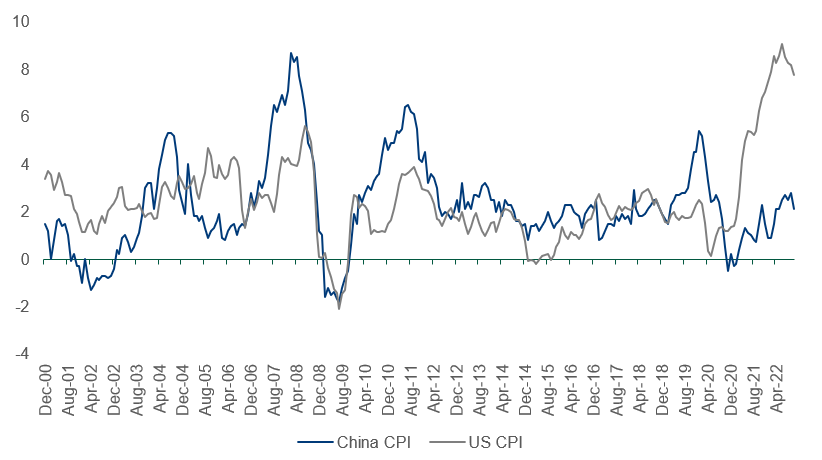
Source: Refinitiv Eikon & Eurizon SLJ Capital, CPI Price change year on year.
A divergent CPI cycle may lead to a divergent economic cycle in China and the US
The difference in CPI between China and US highlights the different output gap between the two economies. China demonstrated a negative output gap (current real output lower than potential output), reflected by weak demand but sufficient supply. However, the output gap in the US is positive (current output higher than potential output) because real demand is not weak, but inflation is high. In other words, we could say, China's potential growth rate suffered less than the US under the global pandemic, as China benefited from labour force, capital, and the supply chain protections. While in the US, the labour force supply has been severely disrupted, which weighs on their potential growth. So, once COVID settles, China has the potential to be more competitive than the US in terms of potential economic growth in the long run. However, in the near term, China will need more monetary and fiscal support to boost demand.
Request a free trial
* For professional investors only, subject to terms & conditions. By submitting your details, you consent to your data being collected and stored for the purposes of Eurizon SLJ Capital Limited providing information regarding your enquiry and related services. If you have any questions about your data please contact us atresearch@eurizonslj.com.
Our Research
Our written research products aim to provide unique and orthogonal insights on key global economic and policy issues in a timely fashion.